
Diversity in our Industry
Increasing Diversity and Equity isn't just good for people, it's good for business.

Introduction
As a leading media technology firm, we pride ourselves on being at the forefront of technology. But to excel as a company, we believe that diversity, equity, and inclusion (DEI) play a critical role in driving innovation and business success. "The Business of Diversity" report published by Rise, offers invaluable insights that resonate with our collective values and operational ethos. It lays bare not just the current landscape of DEI within the industry, but also its direct impact on business performance, hiring and employee well-being. The report's findings are a compelling motivation for all companies to scrutinise their DEI initiatives with the aim of building a more inclusive and high-performing team.
The report highlights the clear benefits of diversity citing the fact that the 40 most diverse vendor companies had 144% higher average revenue-per-employee than the 40 least diverse ones. Diverse companies tend to be more innovative and successful, perhaps, because diverse perspectives and experiences drive creativity and problem-solving. Moreover, organisations that embrace diversity are more likely to attract and retain top talent. Amongst these positive take-aways, when we look at the current landscape, it’s clear there is a long way to go.
Through conversations with focus groups, the report explains that despite efforts to improve DEI, the tech landscape still largely resembles an "old boys' club," presenting hurdles for women and other underrepresented groups. Alarmingly, the report states that 1 in 6 women have been harassed at industry events, 1 in 4 find the content less relevant to them, and 1 in 3 feel unwelcome or ignored. The ethnic diversity of survey respondents was 75% white Caucasian.
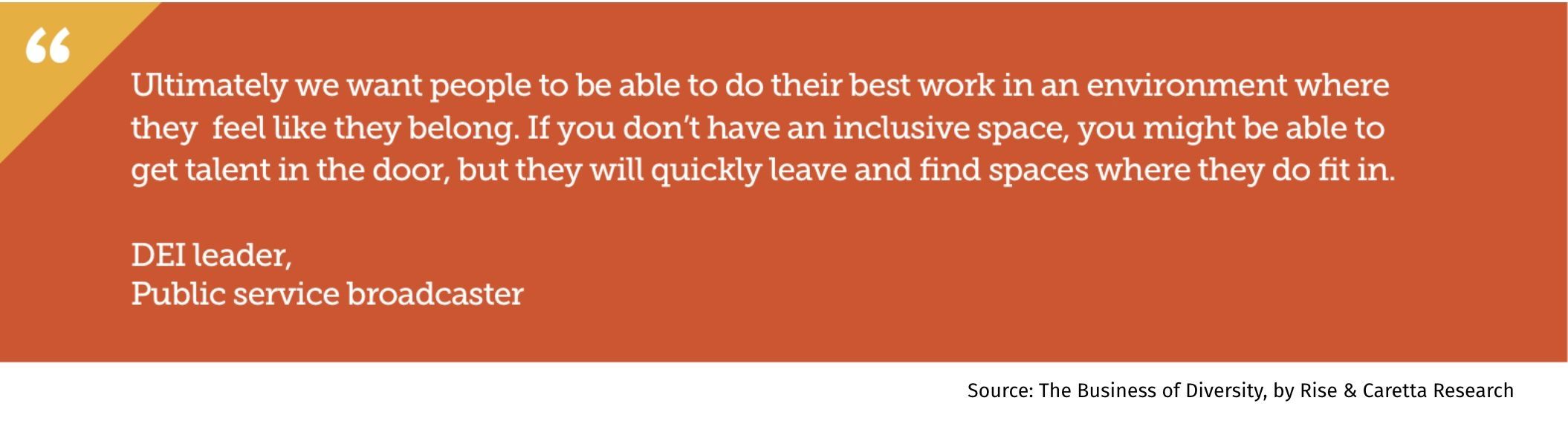
The illusion of diversity
One of the most striking discoveries is the 'illusion of diversity.' Both vendors and buyers overestimate their company's diversity, with 65% of vendors and 85% of buyers classifying their companies as gender-diverse. This false sense of diversity can push DEI initiatives down the priority list.
As a counterpoint to the over-perception of what DEI there is, the report highlights the lack of attention to 'invisible diversity,' such as neurodiversity and LGBT+ status. Over 35% of vendors are unaware of how their companies perform in these areas, emphasizing the need for internal communication around DEI values. "Creating an inclusive environment requires all hands," the report adds.
Climbing the ladder
Globally, CEOs are far more likely to be male and our industry is no exception, with only 12% of CEOs in vendor organisations being female. Representation of women at an executive level is lower than overall representation, signalling issues with promoting women into leadership positions in both buyer and vendor organisations; 85% of men with 10 years' experience had some level of authority compared with only 68% of women. At Techex, women comprise 30% of the board and 40% of senior management positions.

Opportunity to Change
We agree with the report that our industry stands at a pivotal moment when it can either continue to perpetuate the status quo or choose to embrace diversity and inclusion. Techex chooses the latter and recognises the competitive advantage that embedding diversity and inclusion in the company culture brings.
The report also highlights the importance of mentoring and sponsorship programmes in promoting diversity and inclusion. The report quotes a senior executive who says, "Mentoring and sponsorship programmes are critical to the success of women in the industry. They provide a safe space for women to discuss their challenges and aspirations, and they help to build a pipeline of diverse talent for the future."
Flexible working arrangements are one way to promote diversity and inclusion. The report quotes a senior executive who says, "Flexible working arrangements are critical to the success of women in the industry. They allow women to balance their work and personal commitments, and they help to retain talented women who might otherwise leave the industry."
Conclusion
Over the past years achieving diversity, particularly gender diversity, has been increasingly a topic of discussion in the industry. This report reflects a widening of this conversation and gives us a baseline to measure progress against. Within the industry, there is a general agreement on the value of DEI although the actual implementation is fraught with complexities, misconceptions, and a lack of awareness. Acknowledging these issues is the first step toward meaningful and lasting change.
We believe that diversity, equity, and inclusion are critical to the success of the broadcast and media technology industry and will take on a proactive approach to diversity and inclusion, including setting targets and measuring progress, ensuring that diversity and inclusion are embedded in the company culture. The report also highlights the importance of mentoring and sponsorship programmes and flexible working arrangements in promoting diversity and inclusion. The report suggests that the industry must continue to make progress towards greater diversity and inclusion to remain competitive and attract and retain top talent.
Download the report from Rise