What "open" really means to broadcasters
This week, Techex joined a TVBEurope webinar on the move from SDI to IP. One question put to the panel deserves a fuller answer than a live discussion allows: how open is IP, really?
What “open” really means to broadcasters
For broadcasters and streamers, the priority is delivering their services reliably and efficiently. Whether getting a channel to air, bringing a live event to viewers or preparing a news package for a bulletin, the technology and workflows need to support the operational requirements.
How those systems are built and integrated matters, but so do the consequences of the choices made. Broadcasters want to avoid vendor lock-in, unnecessary costs, limited flexibility and restrictions on the functionality available to them. When they ask for openness or interoperability, this is to signal that they want to avoid these practical concerns.
This is important because ‘open’ as the software industry defines it and ‘openness’ as a broadcaster is looking for are often not the same thing. A specification can be published freely and yet still prove hard to adopt. Conversely, a technology can be locked down, but when every vendor supports it, to the end users it seems like an open technology. When everyone has the feature,e it’s like no single supplier holds the keys.
In other words, broadcasters judge openness by its outcomes rather than its paperwork. The technologies that have served them best show how far apart those two measures can sit.
SDI: open through ubiquity
SDI is the clearest example. Almost every piece of broadcast video equipment has an SDI port, and anyone can plug any SDI output into any SDI input and expect a picture. That ubiquity made SDI one of the most successful interoperable systems the industry has ever had.
Yet by a strict definition, SDI was never open. The standards sit behind a paywall, and shaping their future means paying to take part in the standards bodies that maintain them. This is clearly not open.
However, it passes the broadcaster's test with ease. Nobody felt locked in by SDI, equipment came from competing vendors in all direactions, prices fell as the market matured and the interface simply workedwith few interoperability problems overall. Openness here came from ubiquity rather than from licensing or governance, yet for broadcasters it may as well have been truly open.
MXL and tx darwin at IBC Show 2026
Related Webinar

SRT and RIST: code versus specification
The same pattern plays out in contribution over the internet. SRT and RIST solve the same problem, yet they take very different routes to openness.
SRT is open source under the Mozilla Public License, free for vendors to implement and it's maintained by Haivision through its public GitHub project, with the SRT Alliance promoting adoption. Because Haivision has always led development, the reference implementation effectively defines the protocol. Anyone can contribute, but one company holds the final say over where the protocol goes.
RIST is just as free to use, and its open-source library welcomes contributions too. The difference lies in what defines it. The Video Services Forum publishes RIST as a multi-vendor specification, so every implementation, including that library, can be checked against a written standard no single vendor controls. Shaping it requires VSF membership, but the stewardship is shared. If broadcasters truly prioritised open standards and specifications above all else, RIST would be the obvious choice.
In practice, SRT has become open enough. Almost every encoder, decoder, cloud service and software tool supports it, so broadcasters can expect any SRT endpoint to talk to any other. That ubiquity delivers what broadcasters actually want from openness: choice of vendor, low cost and confidence that it will work. RIST, despite its stronger credentials, has not reached the same universal presence.
Openness in a software-defined facility
These lessons matter more as facilities move to systems defined solely by software. In a world of containers, shared compute and functions from many vendors running side by side, the interfaces between software components become the new SDI port. If each vendor exchanges media differently, lock-in returns in a new form.
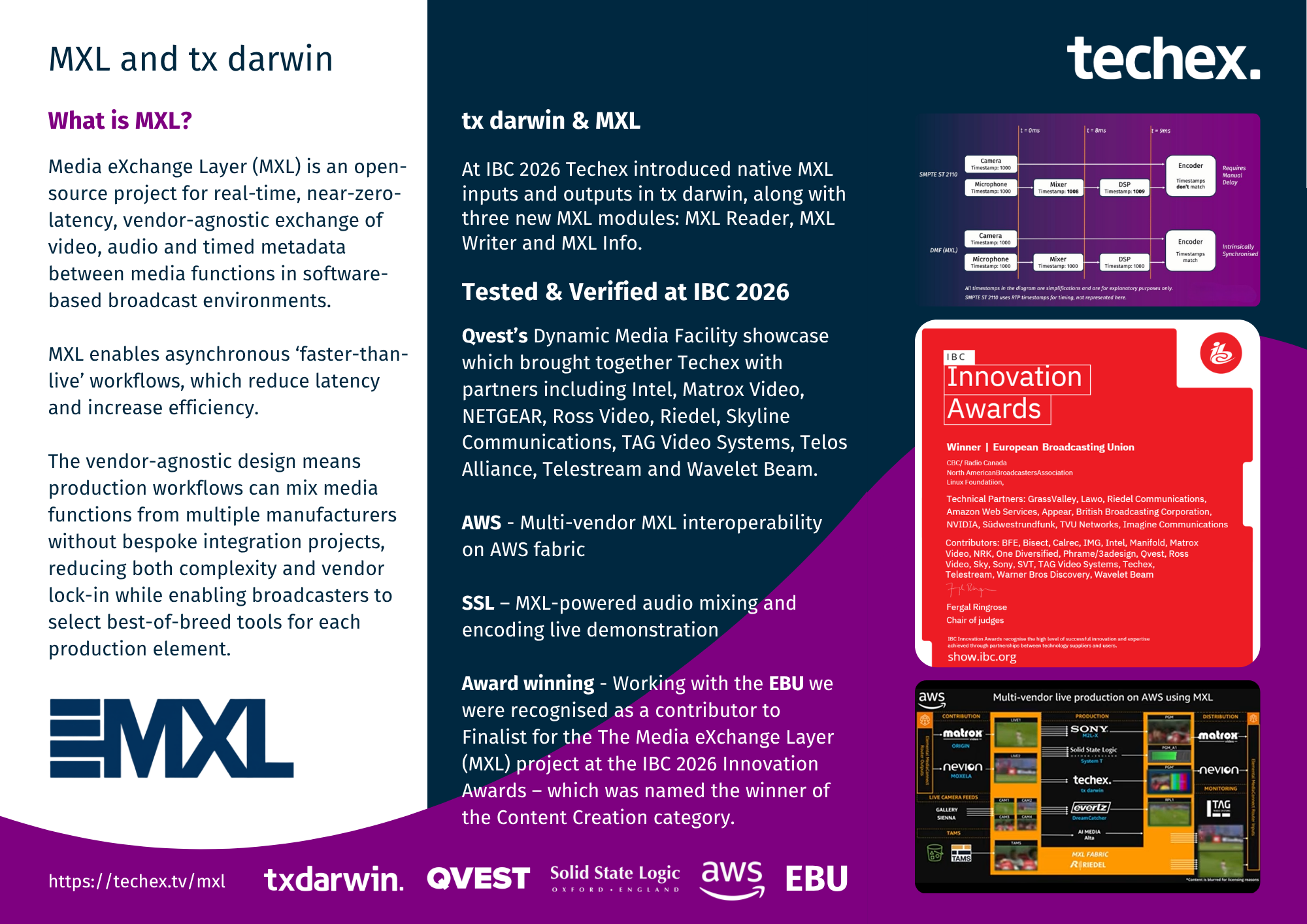
MXL is one attempt to prevent that. It is an open-source project governed under the Linux Foundation, with its code freely available on GitHub, and developed as part of the EBU's Dynamic Media Facility architecture, with contributors spanning broadcasters, cloud providers and vendors. Without MXL, every vendor is implements media exchange in their own way which goes directly against openness and interoperability.
Open source code alone will not make MXL open in the sense broadcasters care about, however. As Roberto Musso noted on the TVBEurope panel, the industry often confuses an open standard with an open ecosystem, and a publicly available specification does not guarantee that a technology is easy to access, implement or integrate. Openness has to be measured from the perspective of developers, manufacturers and end users alike: how much it costs to join the ecosystem, how accessible the tools are and how freely people can build on them. MXL is on track to succeeding by being widely adopted and becoming as unremarkable as SDI is now, by being present everywhere and simply expected to work.
Open and realistic
As the industry works out what open should mean for software-defined facilities, it needs to be both open and realistic. Purity of licence and governance matters, but it is not what decides adoption. SDI and SRT both prove that a technology can win broadcasters' trust while falling short of a strict definition of full openness.
The yardstick should start with what organisations are trying to avoid: lock-in, unnecessary cost, lost flexibility and constrained functionality. Software, specifications and standards that remove those risks, and that are delivered in a way that is open to the user, will earn the ubiquity that made SDI so valuable.
Speaking on the TVBEurope panel, Techex's Russell Trafford-Jones described MXL as "the SDI of the IP world", adding: "We shouldn't have to worry about who's got MXL. If they've got it, then it works, just like SDI." When broadcasters can say the same of every software interface in their facilities, openness will have delivered what they actually need.