
The End of Drumbeat Timing?
Russell Trafford-Jones, Industry Engagement Manager at Techex, explores the challenges broadcast faces moving time from the sync pulse to 'time of day'.
First published in TVBEurope’s MXL in Action ebook, September 2026, produced in partnership with TV Tech.
Timing is a part of broadcast engineering that nobody sees, because it works. Every cut between cameras, every audio mix and every presenter whose lips match their words relies on the system knowing which moment belongs to which. Historically, this is thanks to good planning and dialling in delays where needed. But as we look to base our systems on software-defined infrastructure, timing is set for a shakeup.
Everyone playing to the same beat
The familiar friend for all broadcasters is the synchronisation pulse. Whether black and burst, world clock or one of many others, the idea is the same: a pulse rippling throughout the system ensures all video frames start at the same time and allows audio to keep the correct sync.
Whether you think of it as a drumbeat or as an orchestra conductor, as long as everybody plays on the beat, the system stays coherent. The drumbeat has served the industry well ever since the dawn of broadcasting.
The downside is that a beat tells you when to play but not what to play. A feed arriving three frames late is still perfectly in step since each frame starts exactly where it should. The system simply doesn't know about the delay, so we rely on engineers to dial in an offset until it comes good.
Bar numbers on the score
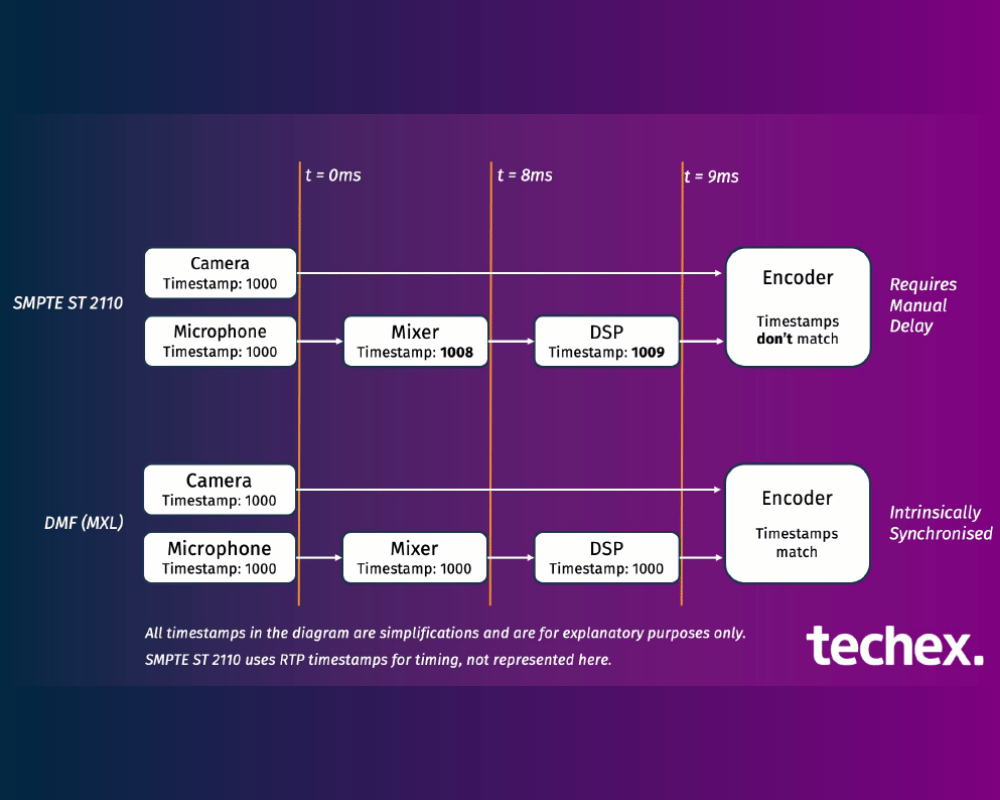
The big change is to write an actual time into the media itself. If time of day is embedded into a transport stream, or timecode is in the video, then delays can be set automatically and we can unlock new workflows.
If a pulse is the conductor's beat, a timestamp is the bar number on the score. A beat tells everyone when to play, whereas the bar number tells them what. Say “from bar 57” and every player lands on the same note.
With the time of day embedded in every feed, you can take media apart, process it, and put it back together knowing which parts match. That opens up asynchronous, faster-than-real-time processing. Latency can vary, branches of different lengths can be recombined, and media can be reunited long after it was separated. This flexibility is what software offers but is near impossible without leaving the drumbeat behind.
Why PTP has not already solved this
Every time an ST 2110 device processes media and sends it on, it stamps it with the current time, which means we lose the origination time. The audio passes through a mixer and a DSP and is re-stamped at each, so by the time it reaches the encoder it no longer shares a timestamp with the picture it was captured alongside. Putting them back together falls to an engineer measuring the path and dialling in a delay.
It is not for want of good time. ST 2110, like AES67, runs on PTP, counting from 1st January 1970 on the TAI timescale, and every RTP timestamp is derived from it. But the industry has mostly used PTP to manufacture a beat rather than as a lasting record of when the media was made.
Read the full article in MXL in Action (pages 12-13)
TVBEurope’s free ebook, produced with TV Tech, looks at how the Media eXchange Layer (MXL) and the Dynamic Media Facility (DMF) are changing software-defined production, with insights from the EBU, BBC and CBC/Radio-Canada.
Click here to download the free ebook.
“Video is written as grains, the smallest unit that stands on its own...while audio is written as samples.”
Russell Trafford-Jones, Industry Engagement Manager - Techex